
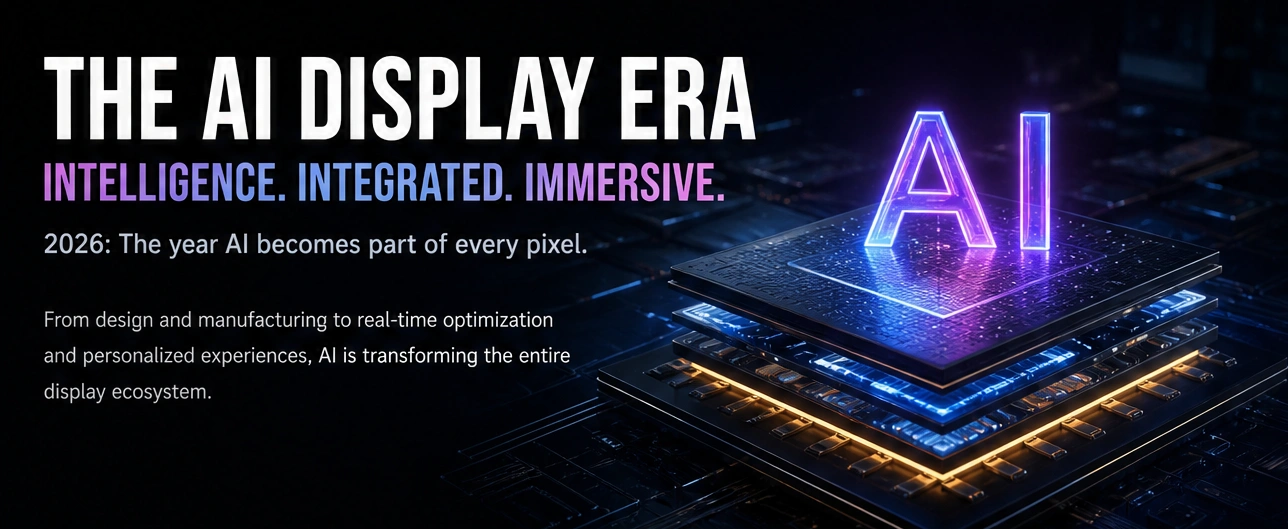
The display industry is undergoing its most significant transformation since the shift from CRT to LCD. In 2026, AI is no longer a buzzword — it's a fundamental driver of how displays are designed, manufactured, calibrated, and experienced. From Samsung's "AI Living" platform announced at CES 2026 to LG's Tandem 2.0 OLED with embedded AI processing, every major player is racing to integrate intelligence directly into the pixel layer.
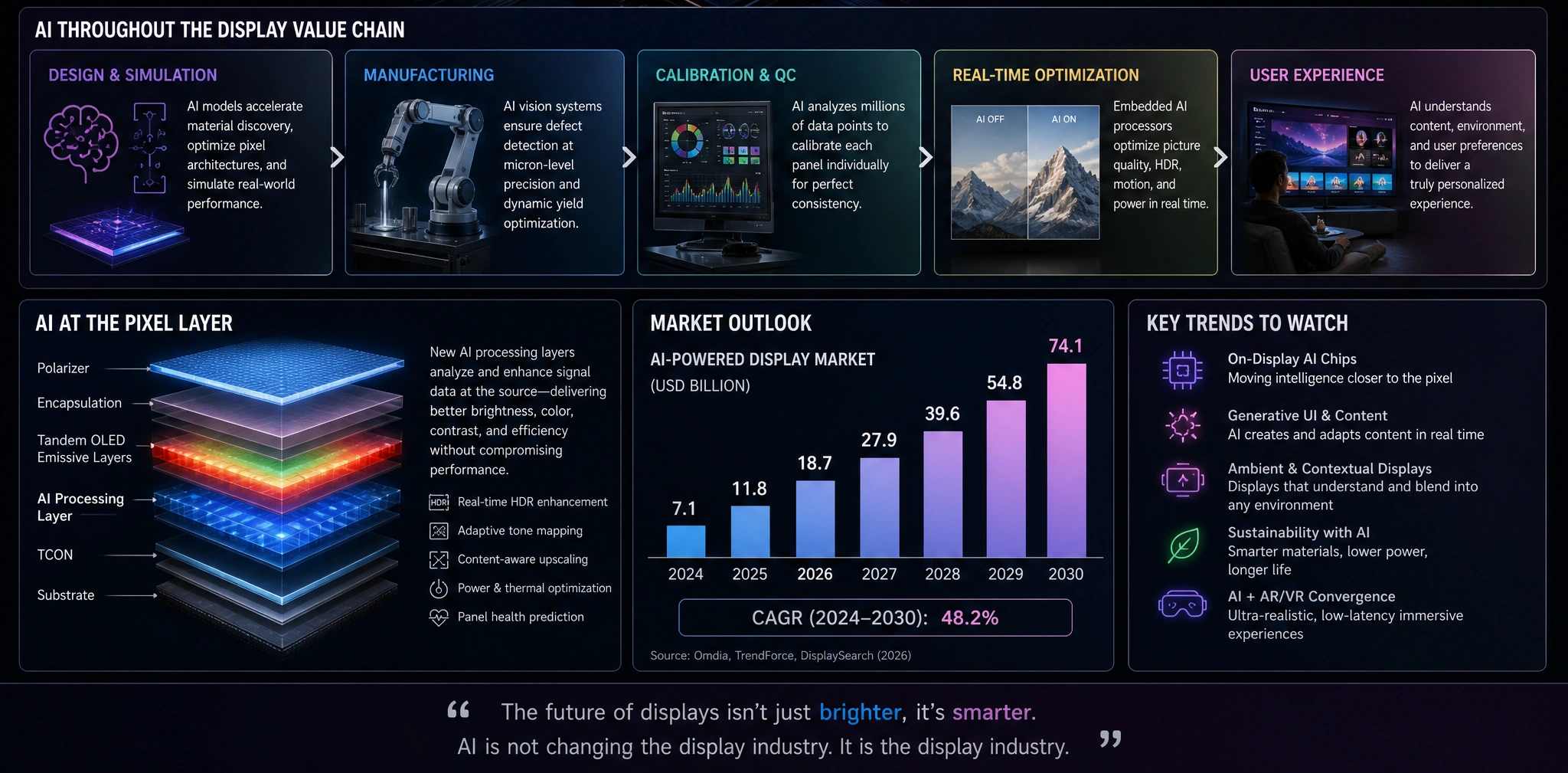
At XHPanel, we've spent over 11 years delivering industrial and commercial LCD solutions to clients worldwide. And what we're seeing in 2026 is unlike any previous cycle of innovation. In this article, I'll walk you through the 5 most impactful AI trends reshaping our industry — backed by real data, trade show insights, and hands-on experience with display modules from 3.5" to 48.3".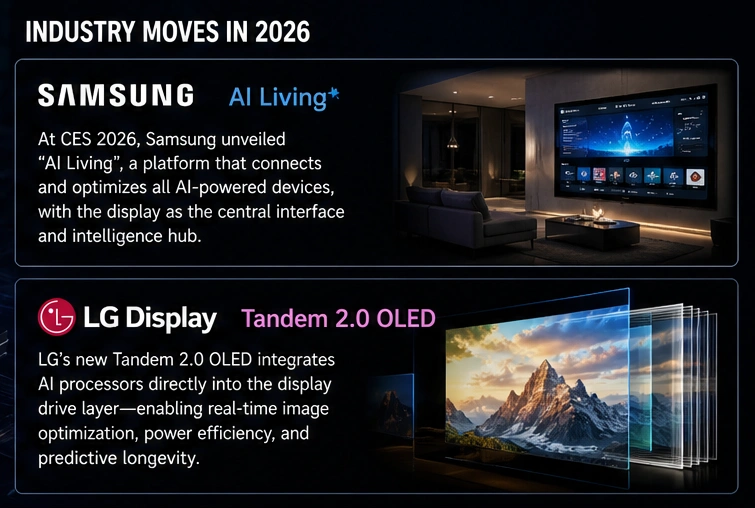
Trend #1: AI-Powered Image Enhancement and Super-Resolution
The first and perhaps most visible trend is AI-driven image enhancement. Modern AI upscaling engines — powered by deep neural networks — can now take a 720p input and produce output that's virtually indistinguishable from native 4K. This isn't marketing hype; it's measurable engineering progress.
Samsung's 2026 Neo QLED lineup features the NQ8 AI Gen3 processor, which uses a multi-layer neural network trained on over 1 million image samples. The result? Real-time super-resolution that adapts to content type — whether it's a security camera feed on a 10.1" industrial monitor or a 4K medical imaging display.
Why This Matters for Industrial Applications
- Legacy content enhancement: Many industrial facilities still run on SD or HD camera systems. AI upscaling extends the useful life of these investments by making footage look sharp on modern 4K panels.
- Bandwidth savings: Transmitting lower-resolution video and upscaling locally reduces network bandwidth by up to 75% — critical for remote monitoring stations.
- Detail recovery: AI models trained on domain-specific datasets (e.g., PCB inspection, medical X-rays) can recover details that traditional sharpening algorithms simply cannot.
Trend #2: AI-Adaptive Brightness and Color Calibration
Traditional display calibration is a manual, time-consuming process. A skilled technician might spend 30–60 minutes per panel using a colorimeter and software like Calman or DisplayCAL. Multiply that across a production run of 10,000 units, and you're looking at a significant bottleneck.
In 2026, AI-driven calibration systems are changing the game entirely. These systems use machine learning models trained on spectral data from thousands of panels to predict optimal calibration parameters in seconds, not minutes. The result:
- Calibration time reduced from 30+ minutes to under 2 minutes per panel
- Color accuracy reaching Delta E < 1 consistently across production batches
- Adaptive brightness that responds to ambient light conditions in real time, adjusting not just backlight intensity but also color temperature and gamma curves
We explore this topic in much greater depth in our dedicated article on AI-Enhanced Display Calibration.
Trend #3: AI-Driven Smart Interaction Interfaces
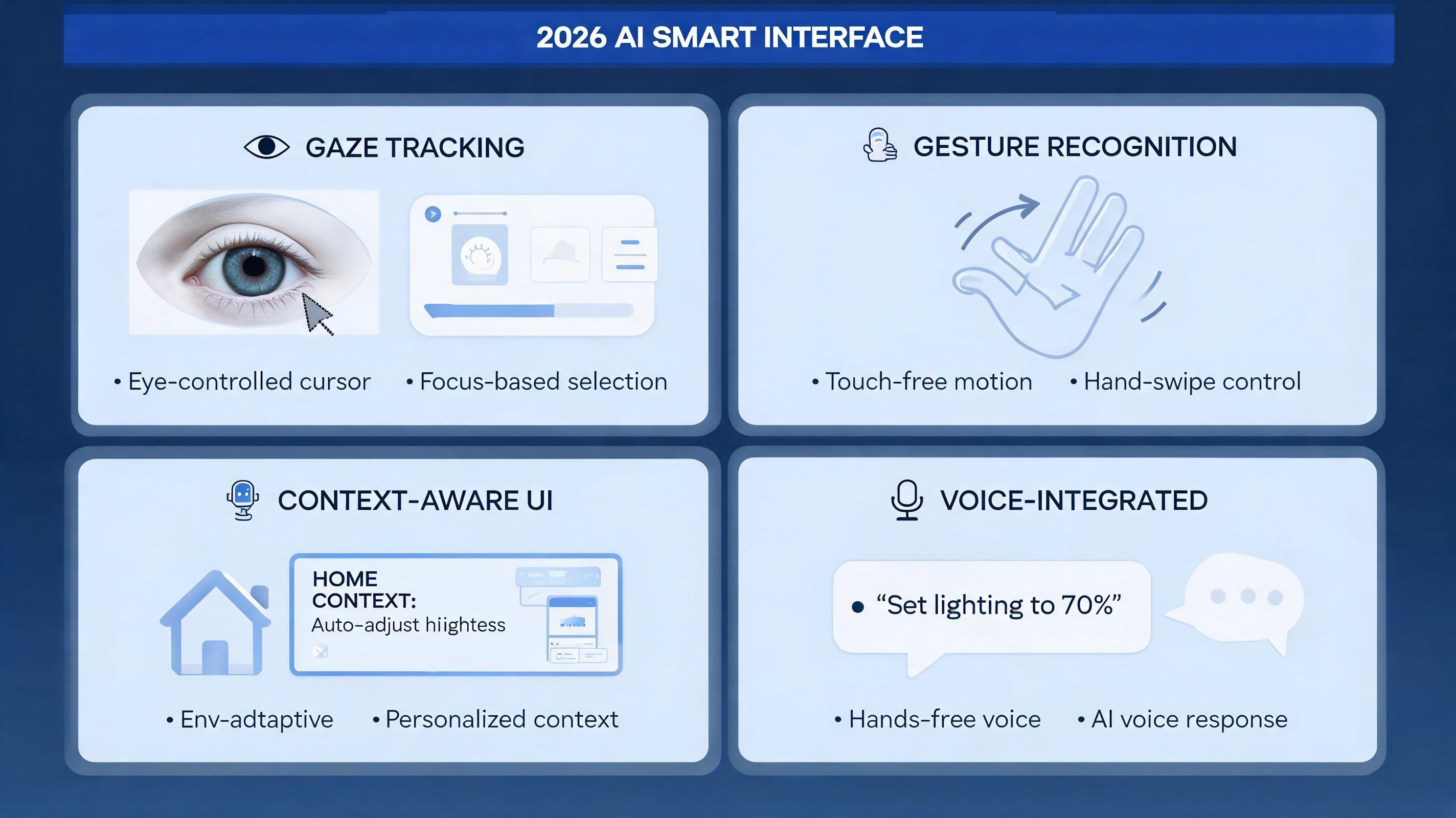
The display is no longer just an output device — it's becoming the primary interaction surface. In 2026, we're seeing a wave of AI-powered interface innovations:
- Gaze tracking: AI algorithms that track where users are looking on screen, enabling foveated rendering that saves processing power while enhancing perceived resolution.
- Gesture recognition: Touchless interfaces powered by on-device AI, crucial for sterile environments like operating rooms and cleanrooms.
- Context-aware UI: Displays that adapt their interface layout based on user behavior patterns, time of day, and operational context.
- Voice-integrated displays: Edge AI processors embedded in display modules that handle voice commands locally, without cloud dependency.
For edge AI devices that demand smarter displays, the interface technology is just as critical as the panel itself. Read our analysis in The Role of Display Interface in AI Devices.
Trend #4: AI in Display Manufacturing — Quality Inspection Revolution
This is the trend that hits closest to home for us as a display solutions provider. AI-powered Automated Optical Inspection (AOI) systems have reached defect detection rates of 98–99%, compared to 85–90% for traditional rule-based systems and roughly 80% for human inspectors.
| Metric | Human Inspection | Rule-Based AOI | AI-Powered AOI (2026) |
|---|---|---|---|
| Defect Detection Rate | ~80% | 85–90% | 98–99% |
| False Positive Rate | Low (but inconsistent) | 10–15% | < 2% |
| Inspection Speed (per panel) | 3–5 minutes | 30–60 seconds | 5–10 seconds |
| Minimum Defect Size Detectable | ~50 μm | ~20 μm | ~5 μm |
| Adaptability to New Defect Types | High (requires training) | Low (requires reprogramming) | High (few-shot learning) |
| Operational Cost (per year) | $80,000–$120,000/operator | $200,000–$300,000/system | $250,000–$400,000/system |
The key breakthrough in 2026 is few-shot learning — AI models that can learn to identify new defect types from just 5–10 example images, rather than requiring thousands of labeled samples. This means when a new panel design enters production at our partner fabs (AUO, BOE, INNOLUX), the inspection system can adapt within hours, not weeks.
Trend #5: RGB Mini LED + AI Image Processing Engines
The fifth trend sits at the intersection of hardware innovation and AI software. Samsung and LG have both announced 2026 product lines that pair RGB Mini LED backlighting with dedicated AI image processing engines.
Samsung's approach uses over 20,000 individually addressable Mini LED zones on a 65" panel, each controlled by an AI algorithm that optimizes local dimming in real time. The result is contrast ratios exceeding 1,000,000:1 — approaching OLED territory — while maintaining the brightness advantage of LCD technology (2,000+ nits peak).
LG's Tandem 2.0 OLED, showcased at SID Display Week 2025 during the "AI in Display" special session, stacks two OLED layers with AI managing current distribution between them. This extends panel lifespan by 40% while achieving 3,000 nits peak brightness — previously unimaginable for OLED.
Implications for Industrial and Commercial Users
- Outdoor signage: AI-managed Mini LED panels deliver 2,000+ nits with precise dimming, readable even in direct sunlight.
- Medical displays: The combination of high contrast and AI calibration enables DICOM-compliant displays at lower cost.
- Automotive HUDs: Mini LED + AI provides the brightness and reliability needed for heads-up displays in varying light conditions.
For a deeper comparison of display technologies for AI applications, see our article From OLED to MicroLED: Which Display Technology Wins for AI?
Expert Take
In my 10 years of working with display panels — from small 3.5" TFT modules for handheld devices to 48.3" ultra-wide commercial displays — I've never seen a technology shift as comprehensive as what AI is driving in 2026.
Here's what I tell my clients: AI isn't just changing what displays show — it's changing how displays are made, how they perform, and how they interact with users. The panels we ship today have AI fingerprints at every stage: AI-optimized glass substrates, AI-calibrated color filters, AI-inspected pixel arrays, and AI-enhanced backlight units.
What excites me most is Trend #4 — AI in manufacturing. When we source panels from AUO, BOE, or INNOLUX, the yield rates have measurably improved thanks to AI-powered inspection. Fewer defective panels in the supply chain means better products for our customers, and ultimately lower costs as yield improvements get passed down.
If you're specifying displays for an AI-powered product or system, the time to engage with your display supplier is now. The technology landscape is shifting fast, and the right panel choice today can give you a significant competitive edge.
Get Expert Advice for Your Display Project
Whether you're developing an AI-powered edge device, upgrading a manufacturing line with smart displays, or sourcing panels for a commercial installation, the team at XHPanel is ready to help.
With 11+ years of experience and partnerships with top-tier panel manufacturers (AUO, BOE, INNOLUX), we provide TFT-LCD modules from 3.5" to 48.3", touch screen solutions, high-brightness displays, and custom configurations for industrial and commercial applications.
Ready to discuss your project? Visit xhpanel.com to request a quote or schedule a technical consultation with our engineering team.


