
Hazardous-area requirements for oil and gas displays apply wherever drilling rigs, well-service units, pipeline stations, terminals, refineries, or offshore equipment may encounter an explosive gas or dust atmosphere. In these locations, choosing a bright industrial LCD is only one small part of the engineering work.
Hazardous-area suitability belongs to the completed equipment and installation. The LCD, backlight, touch sensor, cover glass, controller, power circuit, enclosure, seals, cable entries, wiring, software behavior, and permitted maintenance method can all influence the assessed protection concept.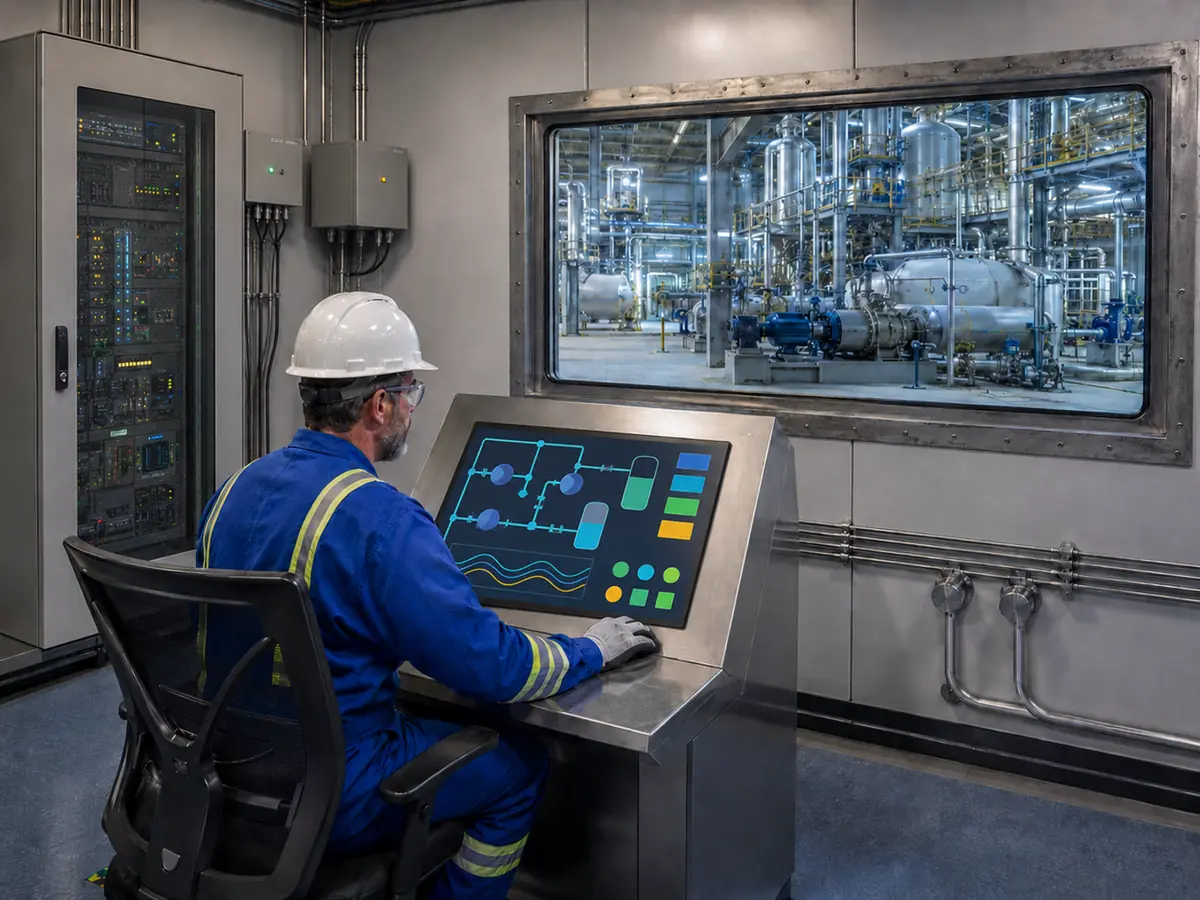
The requirements also depend on the jurisdiction. IECEx, the European Union's ATEX framework, and North American hazardous-location rules use related safety principles but have different legal roles, markings, certification paths, and installation practices. A product accepted under one framework should not be assumed acceptable everywhere else.
Quick Answer: Start with the site's hazardous-area classification and the markets where the equipment will be installed. Define whether the hazard is gas or dust, its group, Zone or Class/Division, required equipment protection level or category where applicable, temperature class or maximum surface temperature, ambient range, protection concept, installation method, and local conformity route. Then assess the complete display assembly against those requirements. An industrial LCD, IP rating, touchscreen, or component certificate alone does not establish hazardous-area approval.
Claim: Hazardous-area compliance is determined by the classified location, complete equipment construction, protection concept, certification evidence, installation, and controlled service conditions—not by the LCD model or enclosure ingress rating alone.
1. What Determines the Hazardous-Area Requirements for a Display?
A display project cannot select an explosion-protection method from the equipment name alone. A pump control panel at one site may be in an unclassified room, while a similar panel beside process equipment may be within a classified location. The area-classification documentation, operating conditions, installation drawing, and applicable rules must establish the starting point.
Direct answer: The responsible site and equipment parties should define the hazardous material, gas or dust group, classification system, Zone or Division, required level of protection, temperature requirement, ambient range, environmental exposure, installation constraints, and destination market. Competent engineers and the relevant certification or approval parties then determine how those conditions apply to the complete HMI.
Who Is Responsible for Classifying the Location?
Classification is normally based on the substances present, credible release sources, release frequency and duration, ventilation, housekeeping, process conditions, and site layout. It should be performed by people competent in the applicable hazardous-area rules and documented before display equipment is specified.
An LCD supplier should not infer a Zone or Division from a photograph or a general description such as “oilfield use.” The equipment manufacturer needs the site requirement, and the owner, engineering authority, authority having jurisdiction, and certification body may each have defined responsibilities depending on the project.
Why Must Gas and Dust Hazards Be Distinguished?
Gas, vapor, and mist hazards are not assessed in exactly the same way as combustible dust hazards. Material groups, ignition characteristics, enclosure behavior, surface temperature limits, dust accumulation, and installation details can change the acceptable equipment design and marking.
How Do Zones and Class/Division Systems Differ?
IEC-based systems commonly use Zones to describe the likelihood or duration of an explosive atmosphere. North American installations may use Class/Division or Zone approaches under the applicable electrical code and workplace rules. Similar-looking terms do not make certificates, markings, or installation methods interchangeable.
Why Are Equipment Groups and Temperature Ratings Important?
Protection selection may need an equipment group, gas or dust subdivision, equipment protection level or category, and temperature class or maximum surface temperature. These attributes relate the equipment to the hazardous material and the required level of protection.
The complete HMI's hottest credible external surface must remain within its assessed limit under the specified ambient, supply, mounting, faults, and operating state. A bright backlight, processor load, sealed enclosure, direct sun, internal power supply, or failed cooling component can change temperature rise.
How Do IECEx, ATEX, and United States Requirements Relate?
IECEx provides an international certification system based on standards for equipment used in explosive atmospheres. ATEX Directive 2014/34/EU establishes legal requirements for relevant equipment placed on the European Union market. In the United States, OSHA 1910.307 requires electrical equipment and installations in hazardous classified locations to be intrinsically safe, approved for the location, or demonstrated safe for the location under the rule.
These frameworks can draw on comparable engineering principles, but their legal status, accepted certification organizations, documentation, labeling, quality controls, and installation rules differ. The destination-country review should be completed before the HMI architecture and certification plan are frozen.
Claim: A valid display specification identifies the classified-location system, hazardous material, group, Zone or Division, required protection level, temperature limit, ambient range, market, and installation—not merely “ATEX,” “IECEx,” or “explosion-proof.”
2. How Can Display Components Affect Explosion Protection?
A display assembly crosses the equipment enclosure at the point where operators must see and often touch it. That makes the front window, retention system, seal, touch construction, and internal electronics part of the protection architecture. Changing a seemingly minor display-side component can alter the assessed construction.
Direct answer: Engineers should review ignition-capable electrical energy, stored charge, component temperature, external surface temperature, mechanical impact, window retention, enclosure integrity, electrostatic behavior, cable entries, fault conditions, and permitted service. The exact relevance depends on the chosen protection concept and applicable standard.
How Can the LCD, Backlight, and Controller Affect the Assessment?
The LCD logic, LED backlight, driver, controller, touch electronics, capacitors, converters, and connectors consume or store energy and generate heat. Normal operation, startup, dimming, communication faults, short circuits, component failures, and an incorrect supply can produce conditions different from the nominal datasheet value.
Hazardous-area assessment therefore uses the defined circuit, component ratings, protective devices, wiring, spacing, thermal paths, and fault assumptions. A lower-power replacement LCD can still be unacceptable if its connector, backlight driver, insulation, materials, or failure behavior differs from the approved design.
Why Are the Window and Cover Glass Safety-Critical?
The viewing window may form part of an enclosure that must withstand specified mechanical, thermal, environmental, or pressure-related conditions. Glass type, thickness, unsupported area, edge finish, printed border, coatings, adhesive, frame, gasket, fasteners, and retention geometry can all matter.
A larger active area or thinner custom glass should not be released from optical drawings alone. The responsible design authority must confirm impact resistance, mounting stress, aging, chemical exposure, temperature cycling, sealing, and the requirements of the selected protection concept.
Is a PCAP or Resistive Touchscreen Intrinsically Safe?
No touch technology is intrinsically safe by name. A projected-capacitive sensor behind glass, a resistive touch panel, or external buttons may be used within a compliant architecture, but the controller, exposed conductors, energy limits, isolation, grounding, cable, firmware, and complete assembly require assessment.
PCAP also depends on tuning through the cover glass and enclosure. Gloves, water, grounding, electrical noise, palm contact, and false activation must be tested, but reliable touch behavior is separate from explosion protection. More integration considerations are covered in How Do Touchscreens Improve Oil and Gas Equipment Operation?.
Can Optical Bonding or Adhesive Changes Affect Approval?
Optical bonding can improve visibility and support the optical stack, but the bonding material becomes part of the physical construction. Its thickness, coverage, cure, bubbles, adhesion, temperature behavior, chemical compatibility, aging, and effect on repairability should be controlled.
How Do Enclosures, Cable Entries, and Connectors Affect the Display?
The HMI enclosure must maintain the protection concept through its joints, window, doors, fasteners, glands, conduit entries, connectors, and internal wiring. A display cable routed through an unapproved opening or a service connector added later can invalidate the intended construction.
Cable type, shield termination, conductor size, bend radius, separation, strain relief, and installation method should match the equipment documentation. Ex-specific entry devices must be selected and installed for the relevant enclosure, cable, hazard, temperature, and certification conditions.
Why Must Electrostatic Charging Be Considered?
Large nonmetallic surfaces, protective films, overlays, coatings, and cleaning methods may create an electrostatic ignition concern in some applications. The relevant limits and mitigations depend on the material, exposed area, equipment group, environment, and protection standard.
Does an IP Rating Prove Hazardous-Area Suitability?
No. An IP rating describes protection against access, solid objects, and water under its referenced test conditions. Explosion protection addresses ignition hazards and uses different construction, assessment, marking, and installation requirements. One does not replace the other.
An oil and gas HMI may need both appropriate ingress protection and hazardous-area conformity. Enclosure sealing, window retention, explosion protection, and environmental qualification should therefore be specified and verified as separate but coordinated requirements.
| Display-Side Item | Possible Compliance Concern | Controlled Evidence |
|---|---|---|
| LCD and LED backlight | Heat, electrical energy, component faults | Approved model, ratings, thermal and fault assessment |
| Touch and controller | Circuit energy, exposed parts, false operation | Circuit definition, firmware, cable, functional tests |
| Cover glass and window | Impact, retention, stress, electrostatics | Controlled drawing, materials, assembly and test evidence |
| Bonding, gasket and adhesive | Aging, sealing, retention, material change | Material specification, process limits, change control |
| Controller and power board | Ignition-capable energy, temperature, faults | Schematic, protection devices, component and thermal records |
| Cable, gland and connector | Entry integrity, strain, wiring and installation | Approved parts, cable schedule and installation instructions |
Claim: The display window, touch stack, electronics, wiring, materials, and enclosure interfaces are controlled parts of the assessed HMI; visual similarity is not evidence that a substitute preserves explosion protection.
3. Which Display Architectures Are Used in Hazardous Areas?
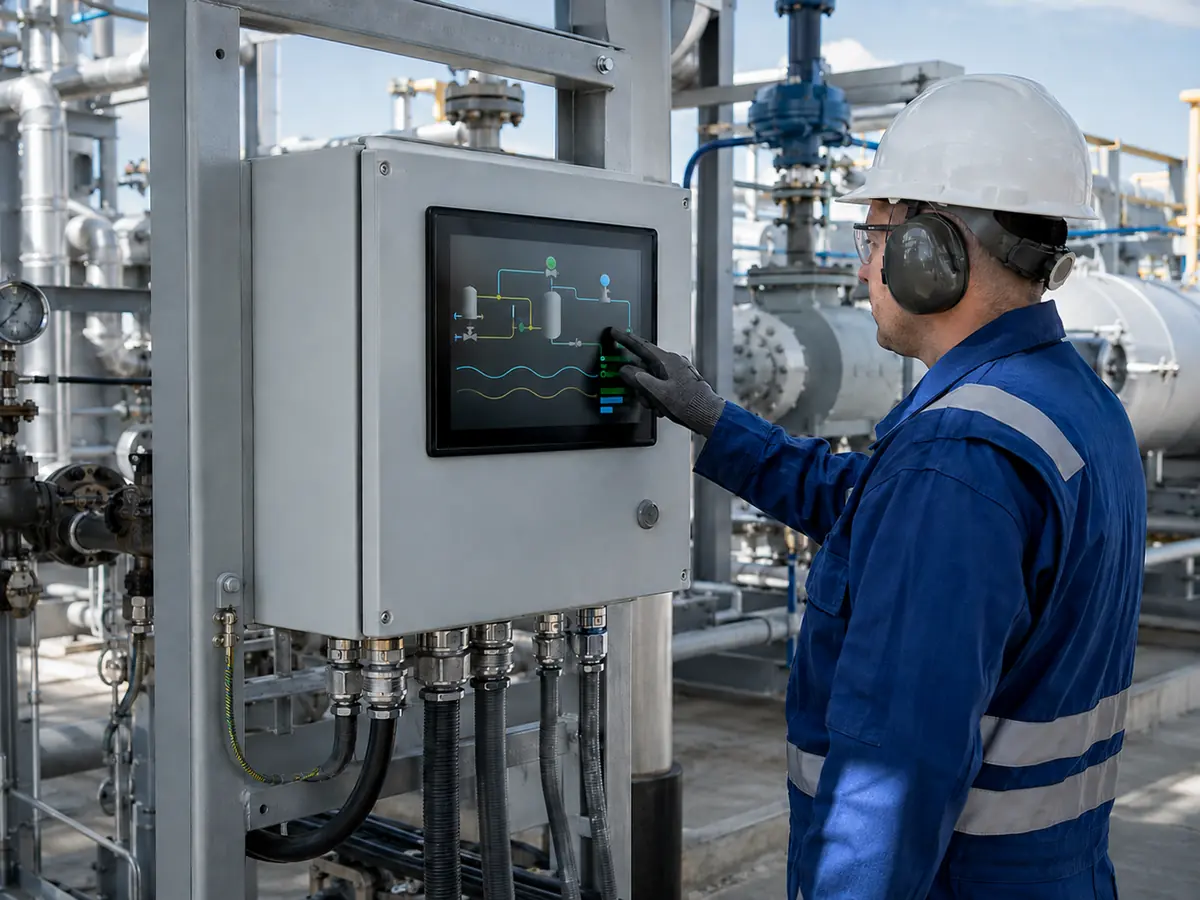
There is no universal hazardous-area display construction. Projects can avoid putting an HMI in the classified location, use a complete certified product, integrate a display into an assessed enclosure, or apply another suitable protection technique. The choice follows risk, classification, operator access, maintainability, optics, power, and local acceptance.
Direct answer: Prefer the simplest architecture that meets the operational task and applicable rules. Locating the display outside the classified area can reduce complexity. Where local viewing or control is necessary, use a complete architecture whose certificate, marking, limitations, installation, and environmental ratings match the location.
When Can the HMI Be Located Outside the Classified Area?
A remote operator station, control room, or cabinet face outside the classified boundary can eliminate the need for the display itself to be installed in the hazardous location. Process data may be carried through an appropriately designed network or isolation boundary.
This arrangement still requires correct field wiring, barriers or isolation where applicable, cybersecurity, communication-loss behavior, alarm handling, and an adequate view of the process. The area boundary and installation must come from project documentation, not convenience.
When Is a Display Installed Behind an Assessed Window?
A commercial or industrial LCD may be mounted inside an enclosure whose complete construction is evaluated for a defined protection concept. The operator views the panel through a controlled window, and touch may operate through the external glass if the assessed design permits it.
This does not turn the bare LCD into certified Ex equipment. The enclosure manufacturer must control the internal heat, clearances, wiring, window, retention, materials, seals, entries, assembly, and permitted display configuration.
When Is a Complete Certified HMI or Monitor Appropriate?
A complete HMI with certification and marking for the required location can reduce integration work, especially when the certificate covers the needed display size, input, touch function, ambient temperature, mounting method, and cable entries. Procurement should check the exact model and suffix rather than a product-family brochure.
When Can Intrinsic Safety or Other Protection Concepts Be Used?
Intrinsic safety limits electrical energy in defined apparatus and circuits so that ignition does not occur under the assessed conditions. It can support some low-power displays, indicators, or operator interfaces, but a panel does not become intrinsically safe because it uses low voltage or USB power. The complete apparatus or system parameters, associated apparatus, cables, grounding, and installation must be compatible.
Other architectures may use flameproof or explosion-proof enclosures, increased safety, encapsulation, pressurization, restricted breathing, or combinations permitted by the applicable framework. Each has specific construction, inspection, service, thermal, and installation consequences. Engineers should select the concept with competent Ex specialists and the certification party rather than adapt a display after the enclosure is complete.
Claim: The safest practical display architecture is determined before component selection and is supported by matching certification, marking, conditions of use, wiring, accessories, installation, and maintenance.
4. How Should Engineers Select, Validate, and Control the Display?
Direct answer: Begin with a written compliance specification, select a defined HMI architecture, engage the responsible certification or approval organization early, freeze production-intent components and processes, complete the required assessment and tests, and control every item referenced by the certification evidence. Installation, inspection, repair, and replacement must follow the approved documentation.
What Should the Compliance Specification Include?
Record the country and installation, area classification, material and group, Zone or Division, equipment protection level or category where applicable, temperature class or maximum surface temperature, ambient range, protection concept, ingress and corrosion requirements, supply, interfaces, mounting, cable entries, and required certification and marking.
Also define display size, active area, resolution, brightness, night dimming, touch and glove behavior, viewing distance, software, startup, alarms, loss-of-signal response, and service life. Broader application conditions are reviewed in Why Does Oil and Gas Equipment Need Industrial LCD Displays?.
How Should Certificates and Markings Be Reviewed?
Verify the issuing organization, certificate status, exact manufacturer, product, model suffix, protection marking, equipment group, level or category, gas or dust applicability, temperature marking, ambient range, drawing revision, and any specific conditions of use. Confirm the certificate is accepted in the destination market.
A component certificate has a different role from a complete equipment certificate and may contain conditions that the final manufacturer must address. A supplier declaration, test report, or label photograph should not be treated as a substitute for the required conformity evidence.
Which Production-Intent Tests Are Still Needed?
Certification tests depend on the protection concept, but functional qualification also needs the real LCD, glass, touch sensor, controller, firmware, cable, power, enclosure, seals, mounting, and software. Test temperature extremes, thermal cycling where required, vibration, shock, humidity, salt or chemicals when applicable, EMC, ESD, power disturbances, sunlight, darkness, and extended operation against documented pass criteria.
Monitor image, backlight, touch, alarm display, startup, dimming, signal interruption, and recovery during applicable tests. Temperature limits should cover the LCD location inside the completed enclosure, including internal losses, solar gain, mounting, and credible operating states.
How Should Installation and Inspection Be Controlled?
Installation instructions should define mounting, fasteners and torque, cable and gland selection, wiring, segregation, earthing or bonding, unused entries, environmental seals, orientation, ambient limits, cleaning, and initial inspection. The completed installation must match its classification and the conditions of the equipment approval.
Periodic inspection and maintenance should follow the applicable site program and standards. Personnel need competence appropriate to their work because a loose cover, incorrect gland, damaged window, corroded bond, or unauthorized cable can defeat the intended protection.
Why Must Repairs and Field Modifications Be Restricted?
Field personnel should not replace the LCD, backlight, touchscreen, glass, gasket, controller, power board, cable, gland, fastener, coating, or adhesive with an unlisted alternative. Drilling holes, adding a connector, applying a film, changing firmware, or increasing brightness can also affect assessed conditions.
The approved service instructions should state which parts can be replaced, by whom, with what inspection and records. Damaged Ex equipment may need evaluation or repair through organizations qualified under the applicable scheme rather than an ordinary electronics workshop.
What Must Remain Under Configuration Control?
Control the LCD and revision, backlight, controller hardware and firmware, touch sensor and firmware, cover glass, window frame, bonding material, gasket, adhesive, fasteners, enclosure, power components, protective devices, wiring, cables, connectors, glands, labels, drawings, assembly processes, test limits, and approved suppliers.
Change notifications should trigger technical, thermal, functional, supply, and certification review. Final functional safety responsibilities also remain separate: hazardous-area conformity does not prove that an alarm display, emergency control, or safety function meets its required integrity.
Claim: A hazardous-area HMI remains compliant only when the production unit, installation, inspection, repairs, documentation, and replacements stay within the assessed configuration and its stated conditions of use.
5. What Advantages Does XIANHENG Offer for Oil and Gas Display Projects?
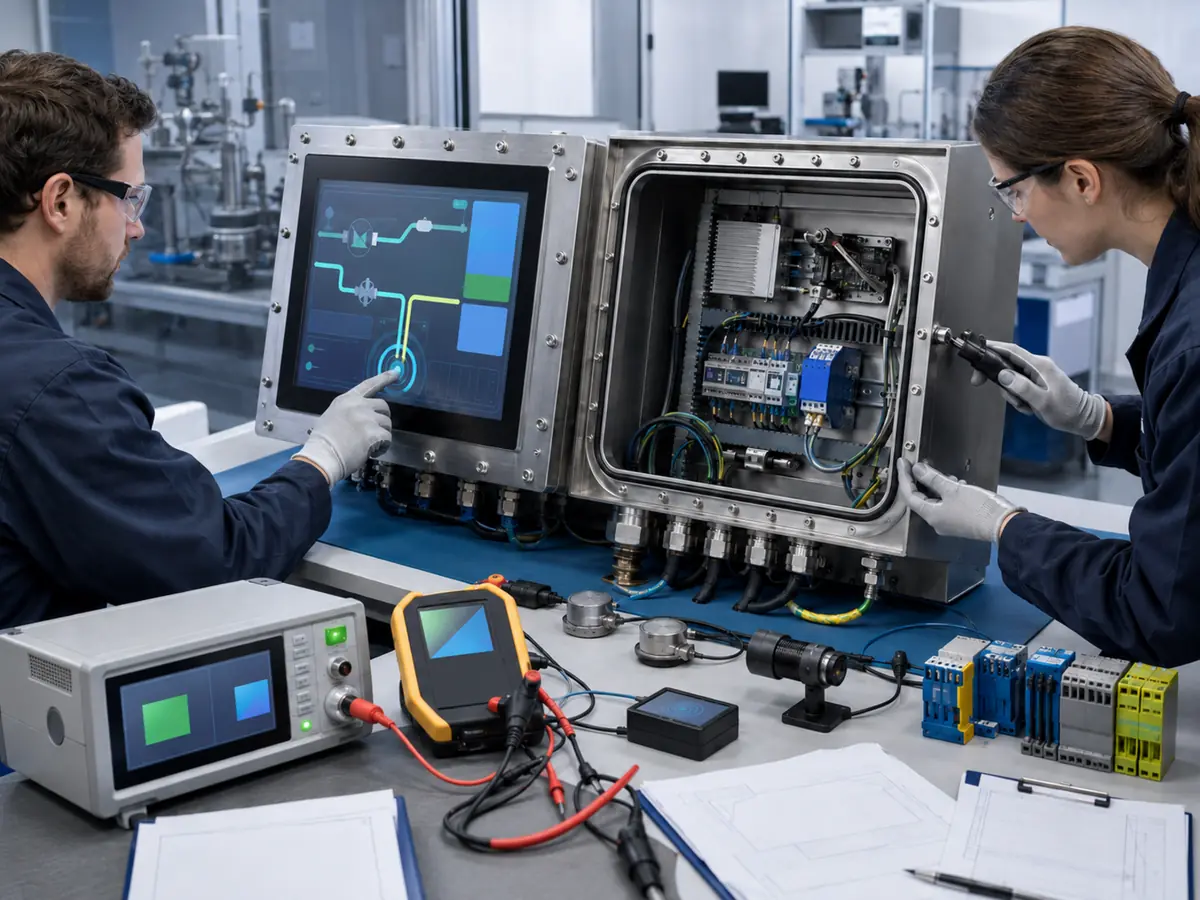
XIANHENG supports display integration for drilling controls, well-service machinery, analyzers, pump and compressor packages, metering skids, pipeline stations, loading systems, refineries, offshore equipment, and remote HMIs. Support can begin with a new certified-equipment design or an existing display subsystem that requires controlled replacement.
Direct answer: XIANHENG can support the display side through industrial TFT LCD selection, PCAP or resistive touch, customized cover glass, optical bonding, controller boards, firmware, customized cables, drawings, samples, inspection, replacement comparison, and lifecycle planning. XIANHENG does not designate the hazardous area or certify the customer's completed equipment; the responsible manufacturer, site parties, and recognized certification or approval organizations retain those duties. Candidate panels can be reviewed in the Industrial LCD Product Collection.
How Can XIANHENG Help Compare Candidate LCDs?
Customers can provide the target size, resolution, brightness, interface, temperature, power, mechanical envelope, expected lifecycle, and the display-related limits defined by the equipment design. XIANHENG can compare panel models across active area, outline, mounting, connector, timing, backlight, thermal data, availability, and revision status.
Can XIANHENG Customize Touch and Cover Glass?
Touch and glass can be developed around the required viewing window, outline, thickness, printed border, edge treatment, touch interface, glove use, water behavior, and enclosure geometry. Drawings can align the LCD active area, sensor, adhesive, gasket, window frame, and cable tail.
Can XIANHENG Support Controllers and Customized Cables?
A controller solution can coordinate the host input, LCD output, native resolution, timing, backlight control, firmware, power, startup, and signal recovery. Customized video and touch cables can define connectors, pinouts, length, shielding, grounding, routing direction, strain relief, and labels.
How Can XIANHENG Support Documentation and Samples?
Project records can include supplier datasheets, dimensional drawings, interface definitions, cable drawings, approved sample identification, inspection items, packaging, labeling, and change-notification requirements. Available component information can be organized for the customer's design and certification review.
How Can XIANHENG Support an Existing HMI Replacement?
Customers can provide the original LCD, touch, controller, cable, glass, drawings, certification-controlled parts list, certificate conditions, software resolution, photographs, failure symptoms, annual quantity, and lifecycle target. XIANHENG can compare candidates for interface, mechanics, optics, power, heat, touch, controller behavior, and supply.
A same-size panel is not automatically an approved substitute. The equipment manufacturer and certification party should determine which drawings, calculations, tests, documents, labels, or approvals are affected before the replacement enters production or field service.
What Information Should Customers Send to Start?
Useful inputs include the equipment type, installation country, classified or unclassified location, display location, responsible protection concept, target marking, ambient range, enclosure and window drawings, screen size, resolution, host interface, touch method, brightness, power, temperature limits, vibration, EMC conditions, original panel, annual quantity, schedule, and required service period.
Do not send confidential certification files unless authorized. To discuss an oilfield HMI display, offshore touchscreen, panel-window assembly, customized cable, controller solution, or obsolete LCD replacement, please reach out to XIANHENG.
Claim: XIANHENG can provide controlled display-subsystem options and evidence for the customer's engineering process while leaving hazardous-area classification, protection design, conformity assessment, installation, and final approval with the responsible parties.


